
Le Deux Roues
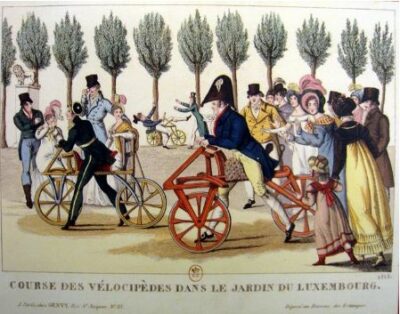 |
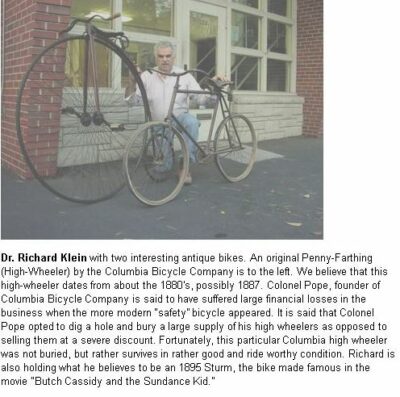
According to the American G.T.Goddard in his book "Velocipede, its history..." (1869) and Axel Josephsson in "Bicycles and Tricycles" (1902), the ancestor of the velocipede was presented at the Place Louis XV (now the Concorde) in 1779 by its inventors, Messrs Blanchard and Magurier, a fact reported in the Petit Journal of July 27, 1779, which describes its eagle-wing steering system. The biggest eruption in recorded history, that of the Indonesian volcano Tambora in 1815, brought disastrous weather to Europe, Asia and America in 1816, known as the year without summer, when horses starved or were killed for food. As Hans-Erhard Lessing shows in his book "Karl Drais - two wheels instead of four clogs", German Baron Karl Drais invented the velocipede in 1817 to make up for the shortage of horses. Cyclists on sidewalks endangered pedestrians, and the velocipede was banned for decades in Germany, England and America. It then spread rapidly across Europe to the point of creating races (1867). |
|
Here again, evolution is incremental and multi-brained:
|
 |
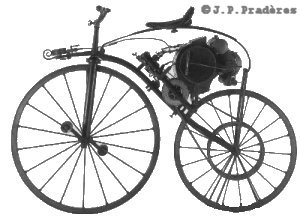 |
Two-wheelers are the simplest and lightest basis for experimenting with engines. In 1868, Louis-Guillaume Perreaux built a motorcycle on a grand-bi frame. Note the vehicle's "hybrid" motorization and "all-wheel drive" transmission. |
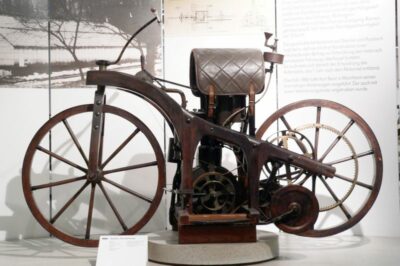 |
In 1885, Gottfried Daimler installed an engine on a wooden-framed two-wheeler to experiment with it without having to solve the fundamental problems. The pragmatism... |
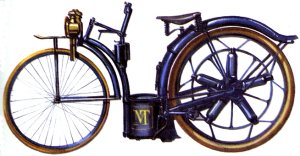 |
Millet's 1888 motorcycle, 5-cylinder star in the rear wheel. |
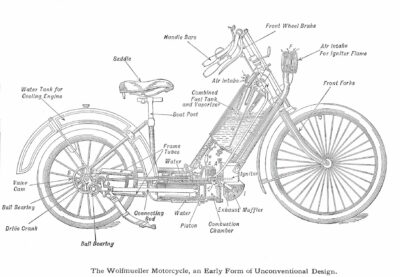 |
Hildebrand and Wolfmuller's 1894 motorcycle, flat-twin, 4-stroke, rod drive. |
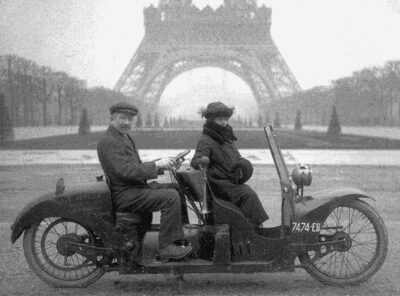 |
Ladies first! The 1922 Parisian La Jumella motorcycle, with push-pull suspension, front and rear shock absorbers, steering? |
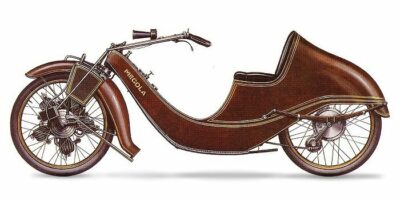 |
The German Megola motorcycle from 1923 is as interesting in terms of aesthetics and technology (5-cylinder star engine inspired by aeronautics in the front wheel) as it is unsuitable. |
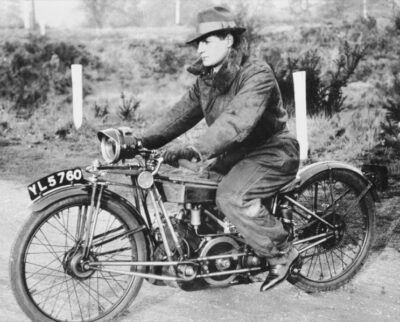 |
George Wallas' 1926 American motorcycle with double-wishbone front suspension. |