Modern Times
|
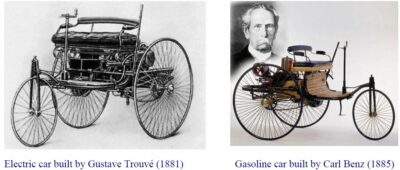
Competition is fierce, between inventors, between manufacturers, and between states claiming primacy. Gustave Trouvé's electric tricycle from 1881 can lay claim to this title. Carl Benz's 1885 0.9 hp tricycle , the subject of patent DRP 37435 dated January 29, 1886, is considered by some to be the first true automobile, since it is combustion-engined (as opposed to steam- and electrically-powered) and designed as a whole. A comparison of the two rivals in the excellent "Historic Corner" section of the EAEC European Automobile Engineers Cooperation Newsletter 02 of 2010. |
 |
|
|
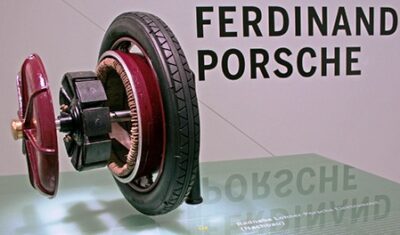
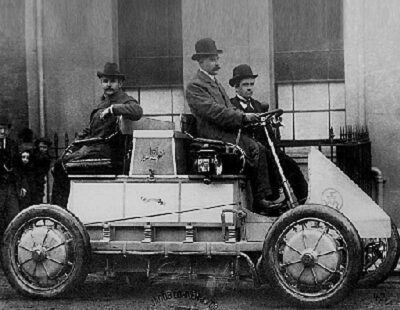
The famous electric Lohner-Porsche of 1900, known in France as the "Toujours Contente" (by antinomy with the "Jamais Contente", see below) was equipped with front-wheel motors. It was upgraded to 4-wheel drive for greater hill-climbing capability, with a 1.8t lead-acid battery, and then with the addition of an internal combustion engine to increase range. Two water-cooled 3.5 hp De Dion-Bouton gasoline engines drove two generators, each supplying 20 amps at 90 volts. This was the first series hybrid. The motor-wheel design not only simplifies the transmission, but also solves the problem of transmission-suspension-steering compatibility.
|
 |
|
| Here's an interesting history of 4-wheel drive in the USA in the early 20th century. | |
|
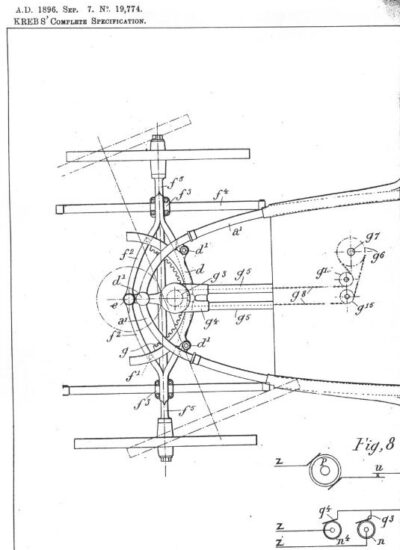 |
From 1896 onwards, Arthur Krebs, as managing director of Panhard-Levassor, invented many indispensable devices:
|
|
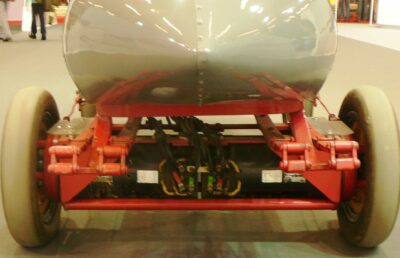 |
La Jamais Contente, the first 100 km/h car in 1901, electric, with a rigid axle and 2 motors, reconstituted by Venturi at the 2010 Mondial. | |
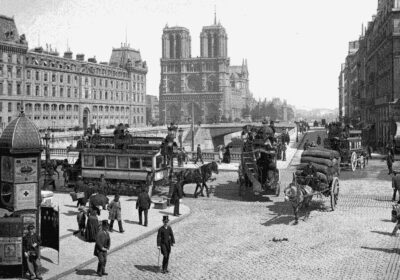 |
30 passengers with two horses, and 40 with 3 - great energy performance for the Parisian horse-drawn streetcar around 1905. | |
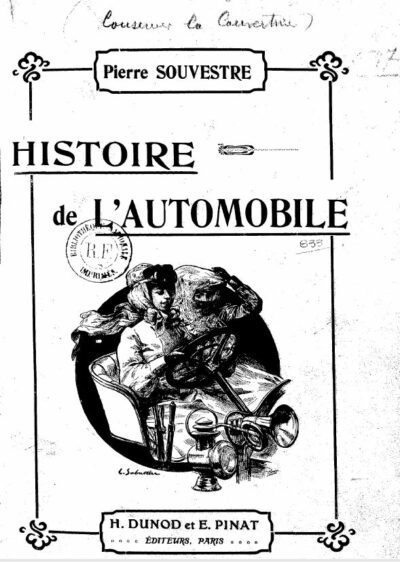 |
In 1907, Pierre Souvestre wrote a magnificent 800-page "History of the Automobile". |