Some remarkable twentieth-century inventions
|
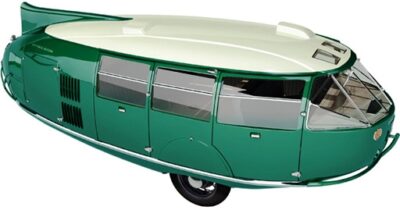
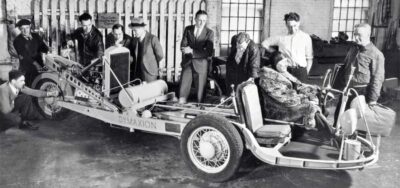
Bucky Fuller's Dymaxion in 1933: great fuel efficiency for 11 passengers, with fuel consumption of 12 l/100 km at 113 km/h, and a top speed of 190 km/h. Only 1043kg, Teardrop bodywork, a nice carry-over with the installation of an 85hp Ford V8 engine with its transaxle and rear axle, but upside down, engine at the rear and rear axle at the front, so front-wheel drive but no steering, so far, so good. Rear axle with 1 steering wheel turning 180°, controlled by a system of cables and pulleys with a gear ratio of 30 and no caster angle! Too many errors. Stability was very poor, but can you blame an inspired American architect for not knowing the fundamentals of automotive dynamics, which had not yet been codified? |
|
|
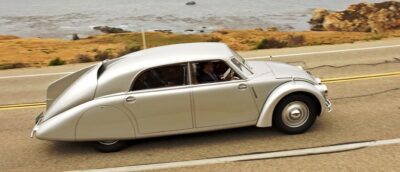
The Tatra T77 of 1938, 6 seats, 150 km/h, the most advanced car of its time, designed by Austrian engineer Hans Ledwinka. A 3.4l V8 engine with hemispherical cylinder head, dry sump pump and air cooling, developing 60 hp at 3500 rpm in the rear overhang position. Body designed by Paul Jaray, three-piece windscreen, with a Cx of 0.212 Independent suspension on all 4 wheels, with half-axle oscillation for the powered rear axle. In 1961, the courts ruled that Ferdinand Porsche had drawn too much inspiration from it for the design of the Beetle. Image credit: © Conceptcarz.com |
 |
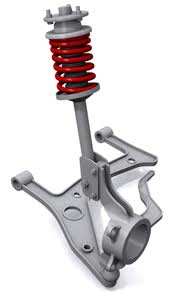 |
MacPherson suspension: one of the most cited names since his 1949 patent, he was an engineer at Chevrolet, where he developed the Cadet, which was never released because it was too expensive, and then at Ford USA. The first series production application was on the French Ford Vedette. 50 years of success, oversimplification, the purist's repellent. For similar reasons, the telescopic front fork on motorcycles is decried, even though it equips 99.9% of all bikes. "Perfection is achieved, not when there is nothing left to add, but when there is nothing left to take away" said Antoine de Saint-Exupéry. Unless you don't achieve the performance you're aiming for. |
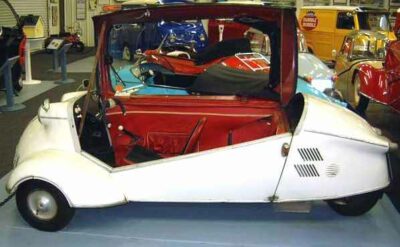 |
In 1953, Messerschmitt developed the KR175, a modern three-wheeled, two-seater in tandem, reaching 130 km/h with 13 hp. |
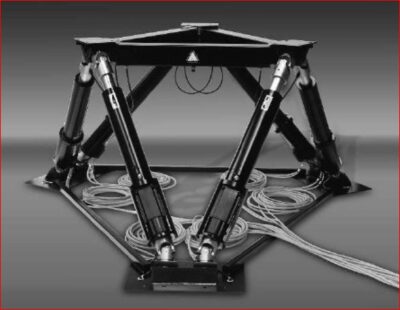 |
In 1955, English engineer Eric Gough of Dunlop built an unpublished hexapod as a tire test stand; this hexapod is also known as Steward-Gough's parallel manipulator or platform, referring to Steward's theoretical description of it 10 years later. Between two solids each defined by a triangle, it allows 6 Degrees of Freedom with 6 cylinders. Its octahedral shape has been known since antiquity as Plato's Solid. Its unsurpassed simplicity has made it widely used in flight and driving simulators. A typical story of modern mechanical inventions? |
|
The gear Harmonic Drive Gear was invented by Walter Musser in 1955 and applied to the Apollo Lunar Rover, as a lightweight, compact and backlash-free high ratio gearbox. The invention is diabolically simple. |
|
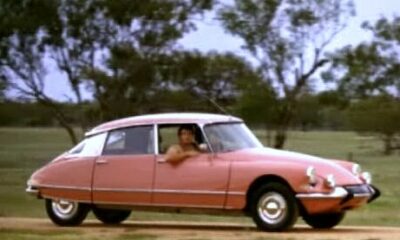 |
The DS Citröen was presented at the 1955 Paris Motor Show. It is revolutionary:
It will unleash passions. |
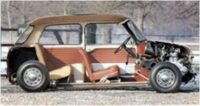 |
The design of Alec Isigonis' 1957 Mini accommodates 4 passengers in 3.05m and 600 kg, which remained unsurpassed for a long time. The small economy cars (Coccinelle, 2cv, R4, Fiat 500) have 4 seats, are mass-produced and make the Three Wheeler disappear. |
|
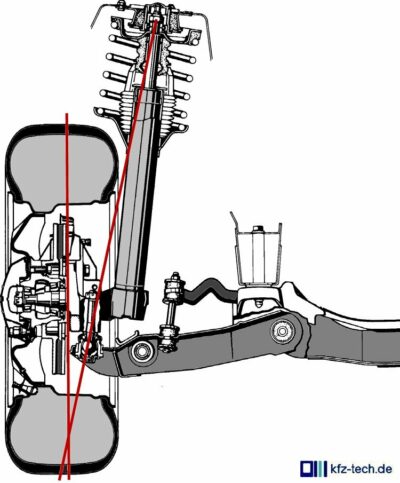
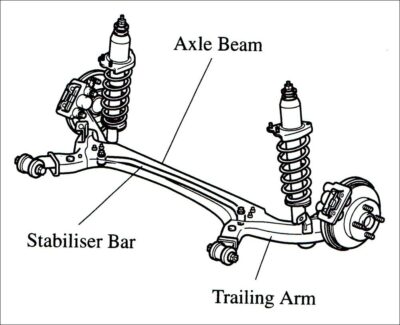
In 1974, the Audi 50 included two major innovations to improve the handling of Tractions:
|
  |
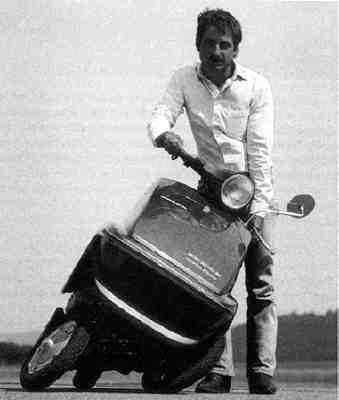 |
In 1984, German engineer Trautwein began developing three-wheel reclining vehicles for Piaggio, the forerunner of the MP3. |
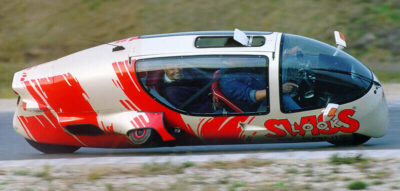 |
The Ecomobile is a two-wheeler with a closed body inspired by the "Tear Drop" of Swiss manufacturer Peraves. Since the 1980s, it has offered the performance of a Porsche (BMW flat twin turbo engine) for the fuel consumption of a Twingo, thanks to its low weight (460kg) and record-breaking aerodynamics (S.Cx=0.18 in the new Monotracer version). |
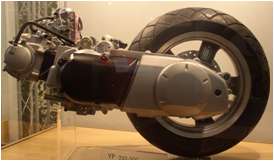 |
A bold example of integration: the scooter engine and its belt-driven CVT transmission in the suspension arm. |
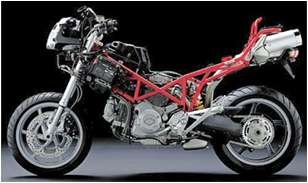 |
A particularly successful and aesthetic example of Ducati engine-chassis integration. |
|
ESP (Electronic Stability Program) was invented by Anton Van Zanten in 1994 for Bosch. It triggers unilateral braking with a highly effective directional effect in the event of skidding, thus reducing loss of control. It is also a very reasonable add-on to the previous ABS system. My money's on little Anton taking up sledging. |