The Renaissance
|
The Renaissance saw the emergence of many brilliant men, combining creativity, technical skill and aesthetic sense. In 1470, Francesco di Giorgio Martini drew in his notebooks a 4-wheel drive and steering vehicle, which, according to Giancarlo Genta, did not work. Leonardo da Vinci's chain-driven bicycle and carriage depicted in his Codex Atlanticus of 1478 were reconstructed by Carlo Pedretti at Florence's Institute-Museum of the History of Science in 2002. The bicycle has pedals, a chain and modern geometry, unlike the draisiennes and grand-bi of the 19th century! But the plan would be a fake! Si non e vero, e ben trovato! There's no contesting "the cart": you can wind it up like a watch for a range of 40 m. The plans are precise and detailed, a brake can be activated from the outside, and the rear wheel has a negative caster, which was certainly made and probably used for theatrical set chaining. To go down in history, avoid wood. |
|
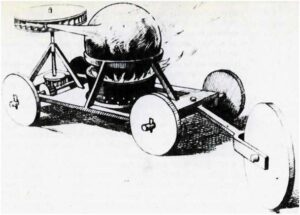 |
In 1669, to arbitrate scientific and religious controversies between shamans and Jesuits, the Chinese emperor Kangxi organized an astronomical prediction contest. Belgian Jesuit missionary Ferdinand Verbiest gave the three correct predictions in all three trials, mainly thanks to his possession of Kepler's Rudolphine tables from 1627, and was declared the winner; he was appointed President of the Tribunal of Mathematics. The official calendar was reformed according to his recommendations, and the loser of the contest was supplicated! He then made astronomical instruments and bronze cannons that have been preserved, and in 1668 a 65 cm self-propelled steam mobile. Note the direction. Continue to avoid the wood. |
|
The full meaning of motor vehicle is an autonomous machine capable of transporting a human being, which disqualifies the previous motives.
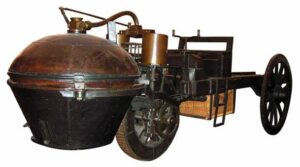
The first would be Cugnot's Fardier of 1769, perhaps inspired by Verbiest's plans, with the addition of a steam engine developed by Newcomen in 1711 for mine pumping. An original coupling of existing technological bricks is also part of the invention. The car had no brakes, which led to the first accident. If you want to be remembered, use the media: the first automobile accident. And on prototypes, don't forget the brakes. |
|
|
Mainly mechanical technology is developing rapidly. In 1485, Leonardo da Vinci designed ball bearings, while in 1534, Benvenuto Cellini created a human-sized swiveling statue of Jupiter in solid silver for Francis I. Thanks to a ball bearing, a small child could turn it. With ocean crossings, it became important to avoid shipwreck, which required maritime charts showing shoals and the ability to locate oneself. In 1714, England launched a competition called the "Longitude Act" for an invention that could determine one's position to within 30 miles after a 6-week voyage, with a "royal" prize. In 1749, the self-taught watchmaker John Harrison added 4 innovations to his maritime chronometer, including the roller bearing, the most accurate of which enabled him to keep track of the time of departure for the duration of an ocean crossing, allowing longitude to be determined by comparison with the astronomical tables established for Greenwich. |
In 1780, the first of the modern ball-bearings supported the main shaft of the Sprowston (Norwich) windmill, whose roof and canopy were oriented to the wind. In 1794, Welshman Philip Vaughan filed the very first patent for logs rolling in semicircular grooves to support radial axle loads. The first log-grinding machine was built in 1883 by German sewing-machine manufacturer Friedrich Fischer. In 1907, Sweden's Wingqvist invented the first self-aligning ball bearings and marketed them for bicycles and automobiles. In 1918, the American engineer Timken patented the tapered roller bearing. In 1922, the needle bearing was patented by Hoffman-Nadella in Germany. |