Fundamental Inventions
| The majority of early vehicles had 2 or 3 wheels, no suspension, a steered front axle and a powered rear axle, because the 4 fundamental problems to be solved to make a complete 4-wheeled vehicle would only be solved one by one. | To find out more, here's a classification of ground-link architectures. |
|
Fundamental problem #1: transmitting motion to two wheels. Understanding the differential in 9 minutes: |
|
|
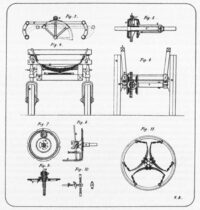
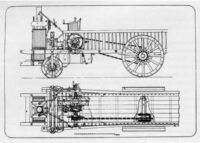
Didier Mahistre reports in his book "100 ans de la moto en Isère" (100 years of motorcycling in Isère) that Jacques de Vaucanson, Grenoble-born watchmaker and Compagnon du Tour de France, presented King Louis XIV with a 4-wheel geared automobile featuring a differential and metal ribbons in 1748 on rue de Charonne in Paris; the 24 plans and his various machines were transferred to the Conservatoire des Arts et Métiers in Paris. Onésiphore Pecqueur, Chef des Ateliers at the same conservatory, patented the differential in 1827, but was also a prolific inventor: in addition to the differential, his 1828 vehicle also featured a steam engine, the principle of which is still in use today, a double-pivot steering system and epicyclic reduction gears in the wheels! |
  |
| Some consider the Swiss Isaac de Rivaz to be the father of the Automobile around 1800, notably for his work on internal combustion engines. | The inventor Isaac de Rivaz (1752-1828) - Henri Michelet - Google Books |
|
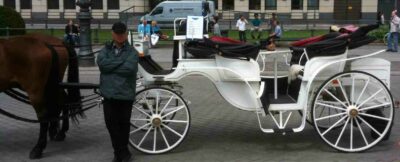
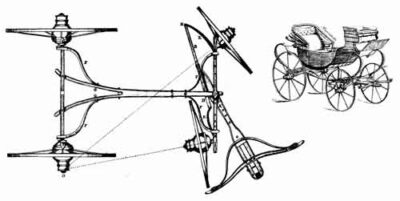
Fundamental problem 2: the geometry of a two-wheel steering gear. For a 4-wheeled vehicle, steering is imperative. The "kingpin" is a central pivot of the drawbar-axle assembly on the chassis, used from the Roman Empire to the 19th century. As urban use requires a high maximum steering angle, this solution results in a large wheel sweep and low habitability. |
 |
|
The dual-pivot axle with individual steering places each wheel on a tangent to the trajectory. Patented in 1818 by the Bavarian Georg Lankensperger and his patent agent Ackermann, it is said to have been created in 1758 by Charles's grandfather Erasmus Darwin, and even earlier in 1714 by the Frenchman Du Quet. Jeantaud's geometry, with the steering levers oriented towards the middle of the rear axle, achieves this condition, a property first enunciated in 1878. It paved the way for the industrial development of 4-wheelers, for example Carl Benz's 1893 world patent DRP 73515, "vehicle steering device with steering circles to be tangentially positioned in relation to the wheels". |
 |
| Fundamental problem no. 3: compatibility of the 3 functions: steering transmission suspension |
Once these three basic functions have been embodied in viable technological solutions, the remaining problem is their kinematic compatibility and integration, which is always the subject of ground connection. As the steering is more on the front axle, the traditional architecture with rear-wheel drive means that we only have to resolve the steering/suspension front and transmission/suspension rear compatibility. The front-wheel drive needed to resolve the triple compatibility of steering, transmission and suspension, which explains why this technological solution had to wait until the 20th century: Tucker, Tracta, Citroen. |
|
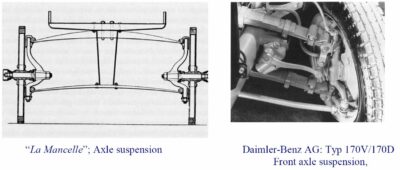
Another great inventor is Amédée Bollée père. His steam-powered vehicles, called l'Obéissante, La Mancelle, La Rapide and la Nouvelle, built in small series from 1872 to 1881, include many inventions that were sufficiently avant-garde to be used for a very long time, such as the independent wheel front suspension with double transverse leaf spring, still in use at MB in 1950. In fact, this was the first independent-wheel suspension, meaning that the wheels are connected by only one elastic element. To find out more about the classification of ground-link architectures, click here. Source: the "Historic Corner" section of the EAEC European Automobile Engineers Cooperation Newsletter. |
 |
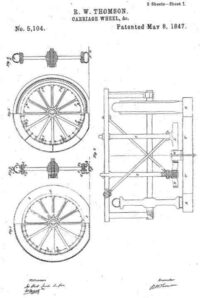 |
Rubber vulcanization (addition of sulfur to render rubber non-sticky and curing) was "invented" by Charles Goodyear in 1839, but had already been used for centuries by pre-Columbian American civilizations to manufacture game balls and footwear. In 1887, Scottish veterinary surgeon John Boyd Dunlop wrapped the wheels of his son's tricycle with an air-filled rubber coil. His patent was invalidated, however, because of the earlier patent by the Scotsman R.W.Thomson in 1845, opposite. Industrial production began in Belfast in 1890. |
|
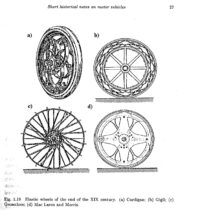
The elastic wheel remained a formidable competitor to the tire for several decades, image taken from Giancarlo Genta, Motor vehicle dynamics, World Scientific, downloadable opposite.
This solution is back in the 21st century with Michelin's Tweel and Airless. |
Motor Vehicle Dynamics: Modelling And Simulation - Giancarlo Genta - Google Books |