
Understanding and Modeling
|
But there can be no inventions without science. Kinematics (from the Greek "kinema", movement) is the "Science in which movements are considered in themselves, (independent of the forces that produce them), as we observe them in solid bodies all around us, and particularly in assemblies called machines", as defined by André-Marie Ampère in 1834 in his "Essai sur la philosophie des sciences". |
The two stars of the study of mechanisms are Leonardo da Vinci, already mentioned above, and the Belgian Franz Reuleaux, born in 1829, considered the father of modern kinematics. His works were published in Germany, Switzerland and England, and his models were collected at Cornell University in the USA and in Germany. Numerical models of its mechanisms are available online, sometimes as interactive graphics, and videos show the results of the calculations: |
|
Some surprising mechanisms It's easy to see where Felix Wankel got his inspiration. |
|
|
Understand and model vehicle dynamics. According to Jean-Pierre Brossard, stability problems were first considered in ship theory, and methods of analysis were found by Archimedes, Euler, Bouguer and Dupin. The first text on road vehicle dynamics was written by Gustave Coriolis [1835] Sur la stabilité des voitures, avec application aux messageries de France. Journal de l'École Polytechnique, 1835. analyzing the overturning condition on sloping ground of double-decker stagecoaches used by messenger services. |
In the modern period, theories have been formalized for vehicles whose problems are more immediate, the bicycle and the airplane:
|
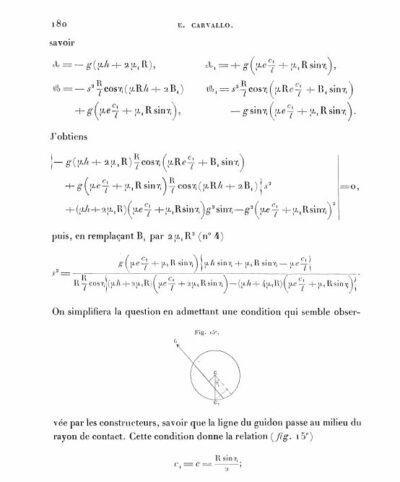 |
Cyprien Chateau published an analysis of bicycle stability entitled "Vélocipédie, de l'aplomb dans les bicycles" in "La Nature, revue des Sciences et de leurs applications aux arts et industries" on November 5, 1892. The Prix Fourneyron, worth 1000 francs (equivalent to around 4000¤ in 2011), is awarded twice a year by the French Academy of Sciences. In 1897, the subject was "the theory of motion and in particular the conditions of velocipede stability". For 10 years, the most brilliant minds were mobilized: Carlo Bourlet, Joseph Boussinesq, Henri Bouasse, Léauté, Paul Appell, Archibald Sharp, Jacob and Francis Whipple. Emmanuel Carvallo published the 200-page "Theory of Motion of the Unicycle and Bicycle", which won him 2nd prize, and in which he formulated the golden rule of two-wheel steering geometry (opposite), still talked about a century later! The thirst for knowledge will subside for a few decades, until computers enable easier and more comprehensive analyses than discussions of literal conditions of stability. |
|
For automobiles, understanding the role of tires is fundamental. The concept of drift was first understood by Brouilhet (Peugeot) in 1925, and an analysis of its role by Becker, Fromm and Maruhn in 1931. Maurice Olley at General Motors invented the words "understeer" and "oversteer" and the notion of critical speed in 1937, while Evans at Goodyear published the first characterization of tire guiding properties measured on a test bench in 1935. |
Two-degree-of-freedom drift-place models, aptly named the "bicycle model", result in a characteristic equation of the second degree, analogous to that of aircraft longitudinal stability. Here, tire drift stiffness replaces the lift gradients of the wings and tailplanes. The first models were developed in France by Yves Rocard (father of), de Sèze (1937), Gratzmuller (1942), Julien (1948), in the USA by Evans and Olley, in Germany by Sharp and in England by Sharp. Three-degree-of-freedom models introduced roll; the first were developed by William (Bill) Milliken, Leonard Segel and David Whitcomb, who came from the aeronautical industry where such models existed, working at the Cornell Aeronautical Laboratory in Buffalo in conjunction with GM; they were presented in three papers in London in 1956, because the American SAE had rejected them! The calculations were carried out on microcomputers, and included qualitative and quantitative aspects, as well as validation against real tests (down to 0.3g), and form the basis of modern automotive dynamics. The next step will be to perfect these models, but above all to take into account the fundamental non-linearity that is the limit of grip: no, you can't simply turn the steering wheel 4 times more to go twice as fast around a bend! |